A block on the road
Look for the side with usable clearance. The visible empty space beside the block is only helpful if the track continues beyond it. A late turn can trade a collision for an edge fall.
A wall or narrow opening
Find the passage rather than following the solid face of the wall. Align while there is room in front of the opening; repeated steering at its entrance makes the available width harder to use.
A break between surfaces
Identify the landing surface before the ball leaves the current one. The important boundary may be the far platform’s side, not simply the empty space directly in front.
An exposed track edge
An edge is present even when no obstacle is nearby. It limits how much room you can spend on the next correction. Treat the outside of a dodge as a boundary, not as spare road.
Read geometry before color
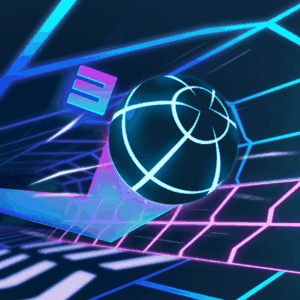
Slope 3 uses a bright neon scene, with glowing structures around the course. A tall background tower is not automatically an object on your route. Look at whether a shape occupies the road the ball is about to use.
A glowing outline can belong to a hazard, the road or the skyline. Check where the object sits relative to the track instead of deciding from color alone. This matters when several glowing shapes overlap in perspective.
Avoid staring at a hazard after you have chosen how to pass it. Move your attention to the next opening. The previous block is no longer the decision you need to make.

| Combination | What becomes scarce | Where to look |
|---|---|---|
| Block beside an open edge | Room to finish the sideways move | The remaining road beyond the block |
| Opening followed by a drop | Time to set up the landing | The far surface through the opening |
| Narrow road after a broad section | Width for the same familiar input | The entrance position before the road narrows |
| Several hazards in view | A line that clears more than the first object | A sequence of usable spaces rather than a single empty spot |
Two easy dodges can make a difficult sequence
Passing the first block on the right may place the ball poorly for an obstacle that needs a left approach immediately afterward. Before committing, look for a line that leaves a workable follow-through. You do not need to memorize an entire course to make that check; the next visible surface is enough to start.
If a crowded sequence ends your run, identify where your options became limited. Was it the last obstacle, or the side you chose earlier? That distinction changes what you should try next. A better first position can remove the need for a large emergency correction later.