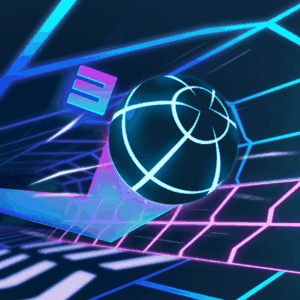
Give each part of the view a job
Near: confirm the margin
Use the ball and the current edges to check whether your latest correction has left room. This is a brief check of a movement you have already made.
Next: choose a destination
Find the opening or platform the ball will reach shortly. This is where the next steering input needs a usable target.
Ahead: notice the constraint
Look for the visible narrowing, break or wall that will make the current easy position less useful. Prepare while there is still road available.

A bright shape is not always your target
Neon buildings can overlap the track in the camera view. Judge a shape by whether it occupies the surface the ball will use. Following a background line can pull your attention away from a much more immediate road edge.
Likewise, a clear patch next to a block is only the start of a route. Follow that patch forward with your eyes. Does it connect to the next surface, or does it finish at a drop? This small check keeps an attractive opening from becoming a poor approach.
You do not need to stare at one distant point. The useful process is a sequence: notice what is coming, choose where to go, check the result and look forward again. Staying fixed on the ball gives you too little warning; staying fixed on the horizon can hide your current margin.
| Question | Useful reference | Less useful distraction |
|---|---|---|
| Have I finished this dodge? | The ball’s clearance from the current edge | The block you have already passed |
| Which side should I choose? | A clear space that continues onto usable track | The nearest empty-looking corner by itself |
| Where should a ramp approach lead? | The far platform’s boundaries | Only the lip of the current ramp |
| What will limit the next correction? | A visible narrowing or wall ahead | Decorative shapes outside the route |
Try an edge-to-connection scan
Choose one visible narrowing or landing as soon as it appears. Find the boundaries of the usable surface, then trace where your present line would meet it. Briefly check the ball’s current clearance before returning your attention to that same target as it approaches.
After the run, name the cue that first revealed the section: a change in road width, a break between surfaces or a wall around an opening. If a background line caught your eye instead, identify the road edge you will use next time. If the landing was hidden, note where it first became visible rather than guessing a fixed route.